Tuesday, 24 January 2017

U.S. governors want say on Trump's infrastructure plan

U.S. President Donald Trump, flanked by Gary Masino (L) of the Sheet Metal Workers Union, Telma Mata (2nd R) of the Heat and Frost Insulators Allied Workers Local 24 and United Brotherhood of Carpenters General President 
Trump holds a roundtable meeting with labor leaders at the White House in Washington
CHICAGO (Reuters) - U.S. governors are flagging hundreds of "shovel-ready" projects they regard as high-priority for President Donald Trump's plan to fix the nation's infrastructure.
Scott Pattison, executive director of the bipartisan National Governor's Association, said on Monday his group, at the request of the White House, has assembled a list of 300 projects costing billions of dollars from 43 states and territories, with more expected to come.
"The good part from a bipartisan standpoint is there seems to be full consensus that we have a lot of infrastructure problems in the U.S., a lot of maintenance issues, also things that need building," he said in an interview.
In his inaugural address Friday, the Republican president said the nation's infrastructure "has fallen into disrepair and decay."
"We will build new roads, and highways, and bridges, and airports, and tunnels, and railways all across our wonderful nation," Trump said.
White House Press Secretary Sean Spicer on Monday told reporters that "infrastructure continues to be a huge priority."
The American Society of Civil Engineers' infrastructure report card has estimated the United States needs to invest $3.6 trillion by 2020.
Pattison said while it was still early in the process, disagreements are likely over how to fund infrastructure. He added that governors want "all the tools" to be made available, including cash, municipal bonds, public-private partnerships and federal matching programs.
"One of the biggest issues that has to be faced is that the gas tax has been primarily the way in which we funded a lot of our transportation projects, and that's a declining revenue source," Pattison said.
Governors also want to make sure their project priorities are immune from congressional earmarking, Pattison said, adding that states have developed "robust" prioritization programs.

Nigeria air strike dead 'rises to 115' in Rann

Nigerian troops during the visit of Chief of Army Staff, LT. Gen. Tukur Buratai patrol the aftermath of a bombing allegedly carried out by the Nigerian Army at a government run camp for internally displaced persons in Rann, Nigeria, 20 January 2017
The number of people mistakenly killed last week in an air attack on a camp for those who have fled conflict in north-east Nigeria has been revised to 115, an official has told the BBC.
Camp residents and aid workers were among those killed when the air force bombed Rann, in Borno state, thinking it was a base of Boko Haram militants.

It was the biggest known botched attack in eight years of fighting the group.
The Nigerian army says it is engaged in a "final push" against the Islamists.
Commanders have apologised for the "accidental" bombing, which they said was because of "the fog of war".
Human Rights Watch said this did not absolve them of responsibility, and called for compensation for the victims.
A local government official from the area, Babagana Malarima, said a mistake had been made when it was earlier reported that the number of those killed had risen to 236.
The error had been made by those in the camp settlement who had added the number of dead to the number of injured to come up with the figure, he told the BBC.
In the immediate aftermath of the attack last Tuesday, the medical charity MSF said 52 people had died.
The wounded were treated in an MSF tented clinic as there are no hospitals in Rann, where displaced people are living in makeshift shelters.
An aid worker told the BBC that the attack, in which at least two bombs were dropped, caused terror and chaos at the camp.
He said he saw dead children lying on the ground, others left as orphans and terrible injuries among survivors.
Child patient in hospital in MaiduguriMap
Aid workers estimated 20,000-40,000 people had been sheltering in Rann, near the border with Cameroon, after fleeing attacks by Boko Haram.
The emergency services official, who spoke to the BBC on condition of anonymity, said all those who had died at Rann had now been buried.
Those critically injured were still receiving treatment in the state capital, Maiduguri, while others were being treated locally by international aid agencies and local services.
The Red Cross has said it has distributed food to more than 25,000 people in Rann since Saturday.
It said they had received enough rice, beans, oil, salt and corn soya blend to last for five weeks.
"People in Rann were happy to receive food. They have been isolated by rains and poor quality roads since June and running very low on food supplies," said Red Cross economic security coordinator Mohammed Sheikh-Ali.
"At the beginning of January, we laid sand bags on the road for our trucks to be able to cross. We got 12 trucks full of food to Rann last week on the day of the air strike, which prevented us [from distributing]. As soon as medical evacuations were over, we organised the distribution with the help of the community."
Twenty aid workers from the Nigerian Red Cross were among the casualties in the air attack.
EDITED BY ENOMA MICHAEL

China hits back at US over South China Sea claims

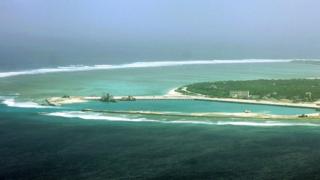
China has asserted its "indisputable sovereignty" over parts of the South China Sea after the Trump administration vowed to prevent China from taking territory in the region.

This aerial view of the city of Sansha on an island in the disputed Paracel chain, which China now considers part of Hainan province on July 27, 2012
The Chinese foreign ministry said Beijing would "remain firm to defend its rights in the region".
White House spokesman Sean Spicer said on Monday the US would "make sure we protect our interests there".
Barack Obama's administration refused to take sides in the dispute.
It did, however, send B-52 bombers and a naval destroyer last year, and the then US Secretary of State John Kerry spoke out over what he called "an increase of militarization from one kind or another" in the region.
Several nations claim territory in the resource-rich South China Sea, which is also an important shipping route.
The new US president has taken a tough stance against China, and Mr Spicer told reporters "the US is going to make sure we protect our interests" in the South China Sea.
"If those islands are, in fact, in international waters and not part of China proper, yeah, we'll make sure we defend international interests from being taken over by another country," he said, without giving further details.
The Chinese government responded by saying that the US was "not a party to the South China Sea issue".
Foreign Ministry spokesperson Hua Chunying said China was "committed to peaceful negotiations with all countries concerned" in the dispute, and said it "respects the principles of freedom of navigation and over-flight in international waters".
But, she went on: "Our position is clear. Our actions have been lawful."

'Devastating confrontation'

Mr Spicer's comments echo those of Donald Trump's new Secretary of State Rex Tillerson.
During his nomination hearing, Mr Tillerson said the US should block access to islands being built by China in the South China Sea, likening it to Russia's annexation of Crimea from Ukraine.
"We're going to have to send China a clear signal that first, the island-building stops and second, your access to those islands also is not going to be allowed," he told the US Senate Foreign Relations Committee.
The Chinese state media responded by warning that such actions would lead to a "devastating confrontation".

What is the South China Sea dispute?

Rival countries have wrangled over territory in the South China Sea for centuries, but tension has steadily increased in recent years.
Its islets and waters are claimed in part or in whole by Taiwan, China, Vietnam, the Philippines, Malaysia and Brunei.
Beijing has been building artificial islands on reefs and carrying out naval patrols in waters also claimed by these other nations.
Although the Obama administration insisted it was neutral, it spoke out strongly against the island-building and sought to build ties with, and among, the South East Asian nations whose claims overlap those of China.
In July an international tribunal ruled against Chinese claims, backing a case brought by the Philippines, but Beijing said it would not respect the verdict.
The frictions have sparked concern that the area is becoming a flashpoint with global consequences.

Sunday, 22 January 2017

White House

Theresa May to meet Donald Trump on Friday

President Donald Trump and Prime minister Theresa May
Prime Minister Theresa May will meet US President Donald Trump in Washington DC on Friday, the White House has said.
Mrs May will be the first foreign leader to meet the new president after his inauguration.
A post-Brexit free trade deal is thought likely to be high on her agenda as she travels to the US for talks.
Confirmation of the meeting came as hundreds of thousands of people around the world joined women's marches to protest Mr Trump's presidency.
Mr Trump's press secretary Sean Spicer gave details of Mrs May's visit in his first briefing to journalists at the White House on Saturday.
Earlier, while visiting the CIA's headquarters, President Trump said the PM "is coming over to our country very shortly".
Nato, the European Union, defence and Russia are all likely to be discussed in the meeting.
The BBC's political correspondent Iain Watson said the "symbolism will be very important" and with Brexit negotiations about to get under way, the fact Mrs May will be meeting the new president so soon will be "politically significant".
Our correspondent said there had been a lot of effort to make sure Mrs May was one of the first leaders President Trump would meet.
In December the PM's joint chiefs of staff, Nick Timothy and Fiona Hill, travelled to the US to build links with the incoming president's team ahead of his inauguration on 20 January.
In a statement issued after the inauguration, Mrs May said: "From our conversations to date, I know we are both committed to advancing the special relationship between our two countries and working together for the prosperity and security of people on both sides of the Atlantic.
"I look forward to discussing these issues and more when we meet in Washington."
Mrs May has promised to hold "very frank" discussions with Mr Trump.
She told the Financial Times she believed the new president recognised the importance and significance of Nato and the "importance of the co-operation we have in Europe to ensure our collective defence and collective security".
On the day after his inauguration, at least 500,000 people gathered for a rally outside the US Capitol building in Washington while organisers said an estimated 100,000 descended on central London on Saturday as similar events were staged in major cities across the US and around the world.

Australian Open 2017

Andy Murray suffers shock defeat by Mischa Zverev

Andy Murray
Murray has finished runner-up five times at the Australian Open
Australian Open 2017
Venue: Melbourne Park, Melbourne Dates: 16-29 Jan
Coverage: Daily live commentary on BBC Radio 5 live sports extra; live text on selected matches on the BBC Sport website; TV highlights on BBC Two and online from 21 January.
Andy Murray's hopes of winning a first Australian Open title ended with a shock defeat by world number 50 Mischa Zverev of Germany in the fourth round.

Murray, the world number one, dropped serve eight times as Zverev won 7-5 5-7 6-2 6-4 on Rod Laver Arena.

It is the Briton's earliest defeat in Melbourne since 2009, and the lowest-ranked player he has lost to at a Grand Slam since the 2006 Australian Open.

Zverev goes on to face Roger Federer or Kei Nishikori in the quarter-finals.

GB's Evans beaten by Tsonga
Watch highlights of day seven on BBC Two from 17:15 GMT on Sunday.
"It was kind of easy to stay aggressive but it was tough to stay calm," said the German, who won in three hours and 33 minutes.

"I was expecting to maybe double fault in the last game but somehow I made it."


Zverev aggression too much for Murray

Murray had been hoping to go one better than five runner-up finishes in Melbourne, but he was unable to cope with the serve-and-volley skills of Zverev.
The 29-year-old German, a contemporary of Murray from junior days, was ranked outside the world's top 1,000 two years ago after a succession of injury problems.
He fought his way back up the rankings with an attacking style that he used to great effect against Murray, serve-volleying 119 times and winning 65 points at the net, while dismantling the Briton's second serve.
Murray ended the match with an impressive 71 winners to 28 unforced errors, but it was still not enough against an opponent constantly putting him under pressure.
The top seed began well, holding points to lead 4-1, but Zverev got the break back with a return winner and would not give the world number one a chance to settle from then on.
Zverev recovered another break in game nine and then moved ahead with a delicate drop volley before seeing out the set.
Murray roared in relief when he levelled at a set all with a rasping winner after again being pegged back twice, but from midway through the third set it was clear that Zverev was the man in command.
He reeled off five straight games to move two sets to one and a break up, and despite one desperately nervous smash into the net - managed to serve his way to victory.
The defeat is Murray's worst at a Grand Slam, in terms of the ranking of his opponent, since he lost to world number 51 Juan Ignacio Chela at Melbourne Park in 2006.
His chances of finally landing the third leg of the career Grand Slam looked to have been enhanced following the surprise defeat of six-time champion Novak Djokovic in the second round.
However, the wait for a first Australian Open title goes on and Murray will turn his attention to Britain's Davis Cup tie in Canada next month.
"He deserved to win because he played great when he was down, and also in the important moments," said Murray.
"I was kind of behind in the last couple of sets the whole way but I have had tough losses in the past and I have come back from them."
Analysis
Leon Smith, Great Britain Davis Cup captain, on BBC Radio 5 live
Andy will obviously be very disappointed but hopefully in a couple of days' time he can look back and realise what he's done over the last decade in Slams is absolutely phenomenal.
So as much as this one hurts, he's got an incredible record and he's got time now to go and prepare for the next one, the French Open and onwards.
Mischa Zverev played great. It was much talked about beforehand, he plays in a way that other players just aren't used to playing against - serve and volley all the time on the first serve, a lot of times on the second, hitting and coming in off returns. It just made it more difficult to get into the match because there's no rhythm.
Jeremy Bates, former British number one
I don't think this has any reflection whatsoever on how the rest of the year goes - they are here to play 18, 19 tournaments I think Andy plays on average per year - he's got all the Slams coming up, he's still world number one and in a very strong position.
One loss is not going to rock the boat too much or blow him off course. If anything it will motivate him to probably work harder - he's somebody who analyses these things, he likes to look into the reasons, what he could've done better, what went wrong and that's his mind, that's the way he works, that's why he's successful and he will use it along those lines to carry on.
He'll probably have another great year, he's in the driving seat.
Andy Murray and Mischa Zverev

Ukraine president to end his sweets deal in Russia

Ukraine's President Petro Poroshenko's most valuable asset is the Roshen confectionery empire, which includes five plants in Ukraine as well as in Lithuania and Hungary
Kiev (AFP) - Ukrainian President Petro Poroshenko's confectionery company on Friday announced plans to shut down his key asset in Russia, a candy factory, after a barrage of criticism at home for his maintaining business activities on rival ground.
The Western-backed leader's business empire ranges from car to media holdings, but his most valuable asset is the Roshen confectionery empire, which includes five plants in Ukraine as well as in Lithuania and Hungary.
Ranked by the Forbes Ukraine website as the country's sixth-richest man, worth $858 million (806 million euros), Poroshenko, 51, has garnered the nickname "the chocolate king".
His most controversial asset is based in the Russian city of Lipetsk, where Poroshenko bought a local confectionary plant in 2002.
Since 2013, the volume of production at the Lipetsk factory has plunged threefold, coinciding with the rupture of ties between Ukraine and its former Soviet master.
After an uprising in Kiev ousted a pro-Russian leader, Moscow annexed Ukraine's strategic Crimean peninsula on the Black Sea in March 2014, and supported a separatist movement in eastern Ukraine that has since claimed about 10,000 lives.
Poroshenko promised to sell his Roshen empire but failed to follow through, citing a lack of foreign interest. He passed his company's shares to a trust firm for management.
The confectionary giant, whose name is based on Poroshenko's name, said in a statement on Friday that it would halt the Lipetsk plant's operations for political and economic reasons, which include Moscow's ban on Roshen imports since 2013.
"Roshen corporation halts manufacturing activity of the Lipetsk confectionery plant," said the company, which is rated among the top 20 companies in the industry and supplies its products to more than 30 countries.
It also accused Moscow of discrediting the Roshen plant's activity in the Russian media as well as encouraging the local authorities to put pressure on its shops across the country.
Poroshenko was repeatedly criticised at home for maintaining businesses in Russia despite his claims that Moscow was an "aggressor".
But Roshen said it was impossible to sell its Lipetsk branch after Russian investigators impounded the factory's property in April 2015.
The company said it planned to cease production at the site by April.

Former President Obama: ‘Yes we did. Yes we can.’

Former President Barack Obama delivered a motivational speech to his staff and supporters shortly after handing over the reins of power to his newly sworn-in successor, President Donald Trump, 45th president of the United States.
“I said before, and I will say again,” Obama said, “that when we started on this journey, we did so with an abiding faith in the American people and their ability — our ability — to join together and change the country in ways that would make life better for our kids and our grandkids, that change didn’t happen from the top down, but it happened from the bottom up.”
Obama delivered his remarks from the Joint Base Andrews before flying to Palm Springs, Calif., with former first lady Michelle Obama, for the couple’s post-White House vacation.
“It was met sometimes with skepticism and doubt,” he added. “Some folks didn’t think we could pull it off. There were those that felt that the institutions of power and privilege in this country were too deeply entrenched. And yet all of you came together … and you decided to believe. And you knocked on doors and you made phone calls. And you talked to your parents, who didn’t know how to pronounce ‘Barack Obama.’ And you got to know each other. … And it grew, and it built. And people took notice. And throughout, it was infused with a sense of hope.”
Obama said he and his wife were simply the “front men and women” for the millions of people who believed in their vision for the country. “But this has never been about us,” he countered, “it has always been about you. And all of the amazing things that have happened over these last 10 years are really just a testament to you.”
His remarks stood in contrast to Trump’s inaugural address, which was at times uplifting but also cast the country in a state of disrepair. Obama further heaped praise on America’s youth and argued that U.S. democracy “is not the buildings, it’s not the monuments,” it’s the people being willing to work to improve the country.
“And that doesn’t end. This is just a little pit stop. This is not a period, this is a comma in the continuing story of building America,” he quipped.
“We look forward to continuing this journey with all of you,” Obama concluded. “And I can’t wait to see what you do next. And I promise that I’ll be right there with you. All right? God bless you. Thank you everybody. Yes we did. Yes we can.”